Sunday, September 6, 2020


ELMER JESPERSON - A MARINE IN WWI 
KILLED AT THE BATTLE OF BELLEAU WOOD

Ninety-nine years ago this month [September 4, 1921], the body of my great uncle Elmer V. Jesperson, was re-interred at the Binghampton Cemetery in Tucson, Arizona.  He had been killed in battle three years earlier in France.  Flags were ordered at half-mast for three days by the mayor of Tucson to pay respect for this young man.


The Marine Corps Muster Roll for the 43rd Company 5th Regiment, June 1918, for “Jesperson, 271933, Elmer V.” asserts, “11-12 Participated in 2 attacks against enemy.  13 killed in action in Bois de Belleau. G.O. 100 does not apply. Character excellent.  Buried on Field of action exact location or date unknown.”  I translated this to mean that on June 11th and 12th Elmer participated in two attacks against the Germans in the battle of Belleau Wood. On June 13th he was killed in action and at some point was buried on the battle ground in the woods.  I have been unable to decipher the meaning of “G.O. 100 does not apply”. [If you know, please contact me.]

Elmer, my grandmother’s brother, was killed in France in WWI and we had been told he was killed at Chateau-Thierry on the banks of the River Marne.  Close, but not quite correct.  We have access to a lot of information regarding most of the earlier wars and, thankfully for me, this includes WWI.  In researching the battle in which he was killed, I discovered a lot about my great uncle, even though his name was never mentioned.

I learned that the 5th Marines is the most highly decorated regiment in the Marine Corps—and it is due to this particular 3-week battle. The fighting these Marines did in the Battle of Belleau Wood has become a key component of their lore and brought about the nickname Devil Dog.

The  French Army retreated that latter part of May before the Germans who were marching steadily forward. After capturing Chateau-Thierry and Vaux on their march to conquer Paris, the German Army moved into Belleau Wood, which stood on high, rocky terrain that hid innumerable gullies.  Urged to turn back by retreating French forces, Marine Capt. Lloyd Williams uttered the now-famous retort, “Retreat? Hell, we just got here.”

At four in the afternoon of June 5th, the troops were given the order to attack Belleau Wood at 5 p.m. The Germans must be driven out.  Only the officers realized it was almost impossible.  General Albertus W. Catlin wrote, “I had perfect confidence in the men; that never faltered.  That they might break never once entered my head.  They might be wiped out, I knew, but they would never break.”

Once they reached the woods, the Marines charged the German machine gun nests, screaming their blood-curdling yell. There were machine gun nests everywhere—on every small hill and plateau, in every ravine and pocket, behind piles of cut timber, and even in the trees. The guns were well placed to cover all zones.  No spot was safe from their spray of bullets. But the Marines never faltered.  They attacked those nests with rifles, automatics, grenades, and bayonets.  The most effective method was to run to the rear of each gun in turn and over-power the crew.  But each flanking position was covered by another gun which had to be taken immediately.  It was a furious dash from nest to nest, with no time to stop for breath. In the thick of the melee the wild yells of the Marines were mingled with the constant crackle of rifle fire like bunches of firecrackers exploding.

“It has been a living hell,” Lt. Clifton Cates wrote to his mother. “We were shelled all night with shrapnel and gas shells… It was mustard gas and a lot of the men were burned.”

Lt. Col. Frederick May Wise wrote, “… I came upon one of those German machine-guns camouflaged behind a brush pile. Dead Marines lay in front of it. Dead Germans lay about it. A strange silence held in the woods. The youngster in command told me of the terrific fighting they’d had.  Foot by foot they had pushed their way through the underbrush in the face of a continuous machine-gun and rifle fire.  Snipers had shot them from brush piles on the ground; from perches high in the trees.  Germans they had left sprawled on the ground for dead as they went on, had risen and shot them in the back…. ‘Whenever we took a machine-gun nest, another one opened up on their flank. That happened many times. The second one would never fire a shot until we had taken the first. Then they opened up on us.’ ”

Casualties were terrible.  Lt. Col. Wise continued, “At the battle’s end I lined the men up and looked them over. It was enough to break your heart.  I had left Courcelles May 31st with 965 men and 26 officers—the best battalion I ever saw any where. … Ten months I had trained them. I had seen them grow into Marines. Now before me stood 350 men and 6 officers; 615 men and 19 officers were gone.”

After the battle, the French general renamed the wood “Bois de la Brigade de Marine” in honor of the Marines’ tenacity. The French government awarded the 5th and 6th U.S. Brigades the Croix de Guerre.

U.S. Secretary of the Navy Josephus Daniels wrote, “In all the history of the Marine Corps there is no such battle as that one in Belleau Wood. Fighting day and night without relief, without sleep, often without water, and for days without hot rations, the Marines met and defeated the best divisions that Germany could throw into the line.

“The heroism and doggedness of that battle are unparalleled. Time after time officers seeing their lines cut to pieces, seeing their men so dog-tired that they even fell asleep under shellfire, hearing their wounded calling for the water they were unable to supply, seeing men fight on after they had been wounded and until they dropped unconscious; time after time officers seeing these things, believing that the very limit of human endurance had been reached, would send back messages to their post command that their men were exhausted.

“But in answer to this would come the word that the line must hold, and, if possible, those lines must attack. And the lines obeyed. Without water, without food, without rest, they went forward—and forward every time to Victory.”

Sources used:
Ancestry.com. U.S. Marine Corps Muster Rolls, 1798-1958 [database on-line]. Provo, UT, USA: Ancestry.com Operations Inc, 2007.
Brigadier General Albertus W. Catlin, USMC. With the Help of God and a Few Marines: The Battles of Chateau-Thierry and Belleau Wood. 1919.
Collin Hoeferlin (Communications Specialist), “The Battle of Belleau Wood,”  MarineParents.com, Inc.
Michael E. Ruane, “The Battle of Belleau Wood was bloody, deadly and forgotten. But it forged a new Marine Corps.” Washington Post. May 31, 2018.
Wikipedia articles “5th Marine Regiment”,  “The Battle of Belleau Wood”


ROLAND L. HAMBLIN
WW2 PILOT BASED OFF USS BLOCK ISLAND
THE ONLY CARRIER LOST IN THE EUROPEAN THEATER 

I think the most scared I ever was, was one time we were way up in the North Atlantic and we were searching a 200-mile-strip for German submarines,” explained my uncle. Roland Hamblin was a pilot in World War II, based off the jeep carrier USS Block Island.  Used specifically against German subs, jeep carriers were about half the size of the big carriers in the Pacific.  They had a flight deck that was 550 feet long and about 60 feet side to side.  

“I was assigned to Squadron VC-55.  We flew bombers and fighters and flew both depending on what was needed.  We were assigned to anti-submarine warfare.  I was hoping for the South Pacific where all the action and glory was, but knowing the Navy, they sent us to the North Atlantic. There were hundreds of German submarines and they were all along the convoy routes destroying hundreds of ships.  They sent us out in the carrier with five destroyers in front of us to protect us from the submarines and a squadron aboard with about 100 aircraft, F4Fs and TBFs.  We had machine guns and rockets and acoustical torpedoes that would home in on the submarines and seek it out.  So we had everything we needed to fight the German submarines.

While searching for submarines, we stayed up about four hours. That meant we could fly about 100 miles, and then we would come back. I was way out as far as I could go and it was a very cold day.  All of a sudden my engine just cut out, and I didn’t know what was wrong. We fly about 3,000 feet so we could see 
the submarines and not be too high or too low. You just drop like a rock when your engine goes out. I gave a quick prayer, I said ‘Heavenly Father, help me.’ Two words came into my mind: ‘Carburetor Heat.’ On my dashboard there was a little pull out knob that was labeled Carburetor Heat. That turned the hot air from the cylinders right onto the carburetor. I turned the knob and just like that, the heat hit it, and my engine started right up. By that time my heart had leaped up into my throat.

Later on when we were off England, we spotted a German submarine and started chasing it. We chased it for nine days and nine nights. We attacked it and it submerged. The next day we made a search around the area where it had gone down. We marked the spot with green dye marker. He would have to come up in a hundred mile area. All day he would stay submerged, and then he would have to come up at night. This went on for nine days. He was going south, thank heavens, instead of north. I was out flying patrol that day and was coming in to land. I noticed that the carrier was going right through this green dye marker.

I came in and reported to the Captain, ‘You just went through the green dye marker.’

He didn’t say much, but just as I climbed into the shower, we got hit by two torpedoes. If you get hit by a torpedo on a ship, it is just like a rock rattling in a can. I hit the floor, then the ceiling, then bounced off the floor again. I jumped out of the shower and grabbed what I could and ran upstairs to the ready room and I reported. About then we got hit by another torpedo. We were told to abandon ship.

            In the Navy through report, the first thing you hear is the boatswain’s whistle. Then a voice comes over the air saying, ‘Now hear this, now hear this’ and then you would get your message. Everyone was listening closely and it said, ‘General Quarters, General Quarters.’ That meant for everyone to report to their battle station wherever it was. Our station was in the pilot’s ready room. We waited there until we got the call to abandon ship. I had my Mae West [life vest] on. I went to the side of the deck where I should have gotten off, but the wind was blowing that way. You couldn’t even get to the edge of the flight deck there were so many people. So I went around to the other side.

The only problem was that when we got off the ship, it was drifting our way. It was drifting about as fast as I could swim. The carrier was about 60 feet high and everything was floating around in the water, so you went down a rope into the water. Once again, I prayed and I got the impression, ‘Swim back, swim back.’ The ship drifted on past us, because we were right behind it then. About that time the stern went down. It just slid right under us. If we had been any closer, it would have sucked us under with it.

We thought we were safe, but then when it got down about 200 feet, all the depth charges that had been set for 200 feet started going off. There were explosions all around us. Big old geysers of water. Once again, I prayed and Heavenly Father helped me. I got the impression, ‘Get your feet up, get your feet up.’ I floated up above all that debris from the explosions. There were terrible sharp concussions and the water was covered with oil, so the sharks didn’t bother us.

This happened about 8 o’clock at night and we got picked up at midnight. Thank goodness we were in the South Atlantic where it wasn’t nearly as cold. We wouldn’t have lasted as long in the North Atlantic.

Besides hitting the carrier, the submarine torpedoed one of the destroyers. We saw the torpedo go by; it was an acoustical one and hit the destroyer right in the screws. One of the other destroyers went to take care of the ship that was hit and the other two destroyers went ahead and found that German submarine and sunk it. It had stayed down as long as it could and when the carrier passed over it, it gave up and came to the surface and fired everything it had. It couldn’t submerge any more, the batteries were run down and it was exhausted. So they finally sunk the sub. Then they pulled up in the area where we were.

I got over to one of them about 11:30 that night and wanted to get aboard and they said, ‘Sorry we can’t take you. We just can’t take any more survivors.’ Then they continued, ‘If you can get over there to the other one, they will probably pick you up.’ So we went over to the other destroyer and they said to come up. That was one of the hardest things I have ever done was to climb aboard that destroyer.

There was another person climbing up the same time as I did, and I thought he was Black.  When I got up and looked at myself, I realized I looked just like he did.  We were covered with oil. They gave us a shower. It was a salt water shower which was all they had. They gave me a t-shirt, and that was all I had to wear for four days until we got to Casablanca [Morocco].

We had six planes up at the time we were torpedoed. They sent them to the nearest land, which happened to be the Azores. There was no landing strip in the Azores at the time, so they all tried to land in the water and coast up to the beach. One of the pilots took his life jacket and little lifeboat, and he was picked up by a PBY the next day.  We thought he was the only one to survive.”

My uncle blamed the sinking of the ship on the Block Island’s captain for crossing into the green dye. Additional reports state: “With three kills credited to her squadron, she was an experienced anti-submarine unit, but she remained the only US carrier lost in the European theater.” Barrett Tillman, Wildcat: The F4F in World War II. The attached destroyer Ahrens, built and equipped to carry a crew of 200, picked up 674 survivors, nearly weighing its deck down to sea level.

“The 277 survivors left in the oily brine full of stinging Man of Wars had to swim for four hours to reach the Paine.  One reported that when the depth charges went off, it felt like getting an enema with a telephone pole.  Most were too exhausted to climb up the rope ladders and had to be pulled up by strong-armed crewmen.  Then they collapsed when they tried to stand on deck.  Any clothing, oily-soaked, left on them was cut off and thrown overboard.

Thirteen men from the Block Island were lost. Four of the six Wildcat pilots left in the air also died that night. The Block Island survivors arrived in Casablanca on June 1st and were issued marine khakis and kept in isolation to keep news of the ship’s loss from leaking out.” D-Day followed five days later, June 6, 1944.


Friday, January 10, 2020

Joel & Rogers Savage: brothers with very different Revolutionary War Experiences

JOEL & ROGERS SAVAGE: BROTHERS 
WITH DIFFERING REVOLUTIONARY WAR EXPERIENCES


Brothers Joel and Rogers Savage both served as privates in the Army while in their teens during the Revolutionary War. They had very different experiences from each other.

My 3rd great grandfather, Rogers Savage, was twelve when the cry for independence was sounded.  Born May 14, 1764 to father William Savage, age 38, and mother Martha Gibson Savage, age 28, in Middletown, Hartford, Connecticut, Rogers was baptized as an infant in the Presbyterian Church at Middletown.  He was child number 4 of the 11 who would be born to William and Martha. His brother Joel, born Sept. 25, 1761, also in Middletown, was three years older.  Over the course of several years, the family would move from Central Connecticut to Western Massachusetts to what would become the State of New York.

A year after the Revolution commenced and while they were living in Sandisfield, Massachusetts, older brother 15-year-old Joel enlisted in the Continental Army in May 1777, for the term of three years. Immediately marching south over 100 miles to Peekskill, New York, the Massachusetts troops joined those of New York and marched another 113 miles north to Albany.  Stillwater lay 23 miles to the north of Albany where the men engaged in a severe battle against British General Burgoyne.  

This battle, now known as the Battle of Saratoga, pit 3000 fighting soldiers on either side, neither able to soundly defeat the other. To fight without being beaten was to the Americans practically a victory and, accordingly, the news of the battle was received with joy and exultation throughout America.  British General Fraser was killed and a few days after this battle, Joel was detached as a hospital guard to go to "Landingburgh".

The British retreated from Fort Stanwix after the Battle of Saratoga and the patriots never again faced a major force in upstate New York. The Iroquois and Tory raiders launched bloody hit-and-run raids on the less defended settlements and farmsteads in New York and the war continued. 

Joel returned home in the fall after his 16th birthday.  At age 18, as the British were not yet defeated, Joel again enlisted in his same Massachusetts regiment for another 6 months. After his return the following spring, his father’s family moved across the state border into Canaan, New York. 

Five months later, for reasons unknown to us, Joel enlisted as a substitute for his brother Rogers, a month before his 20th birthday. Stationed at Fort Herkimer, New York, Joel joined Captain Solomon Woodworth's company of Rangers.

A party of Indians was discovered Sept. 7, 1781. Taking rations for 7 days, Joel, one of 42 privates, the officers, 5 Stockbridge Indians and an Oneida guide, left Fort Herkimer in pursuit. Crossing West Canada Creek, the rangers chased the Indians and were ambushed.  In the bloody fight that followed, all officers and 23 privates were killed. A few were able to make their escape back to Fort Herkimer.  Joel and 5 others were captured and taken to British Fort Niagara. 

At Fort Niagara Joel had to run the gauntlet. Running the gauntlet is a former military punishment in which the offender was made to run between two rows of men who would strike with switches or weapons as he passed. Often a sergeant would walk backwards in front of the prisoner with a sword pressed against the man's belly to keep him from running, while forcing him forward with a rope tied to the man's wrists. After running the gauntlet twice, Joel was dressed in Indian clothing and given as a present to Col. Butler, a Tory or Loyalist officer, who commanded a regiment of rangers in the British Army.


Given the opportunity to take up arms against his country, Joel refused. He was confined in the guard house for 12 days. Joel was moved to a dungeon on Carleton Island in the St. Lawrence River for four weeks until he was transferred again. After an 11-month-imprisonment through the bitterly cold winter and muggy summer on an Island 40 miles above Montreal, he was moved to Montreal and then to Quebec.

The British knew the war was lost. Joel was taken on board a British ship and sailed to Boston as part of a prisoner exchange Nov. 28, 1782. A preliminary peace treaty was signed in Paris two days later.   Joel had been a British prisoner for nearly 15 months.

Meanwhile, the previous June (1782), 18-year-old Rogers had enlisted as a soldier in Berkshire County, Massachusetts, for the term of three years.  Immediately upon conscription, he marched nearly 60 miles to Springfield, Massachusetts, where he was mustered by an officer sent from the Continental Army.  The recruits trained at Springfield and then marched 130 miles to West Point.

Upon arrival at West Point, Rogers served in the 6th Massachusetts Regiment commandeered by Col. John Kilby Smith. Later that year they joined the French Army and marched 15 miles south to Verplanck Point.  In the fall of the same year, the troops marched 24 miles north to New Windsor where they erected huts for Winter Quarters.   After finishing huts for officers and soldiers, they erected a large building for meetings and a conference house for the officers.  The news of the peace treaty (Nov. 30, 1782) arrived with great rejoicing, and those who had enlisted for the duration of the war were discharged upon six months furlough. Rogers received orders to march to West Point.  

In June 1783 Rogers marched with troops to Philadelphia to quell the violence. Distressed at receiving no pay for their service during the Revolutionary War, 400 Continental soldiers stationed in Philadelphia mutinied. Attempting an attack on Congress, they proceeded to break open the Bank to obtain their pay.  Rogers wrote, “On our march we passed by a number of the members of Congress in Princeton who had fled there for safety who stood with heads uncovered and their hats in their hands until our brigade had passed them.  When we arrived at Philadelphia the mob was dispersed, two of the leaders having been taken and sentenced to be shot but were subsequently reprieved.” 

On Sept. 3, 1783, The United States and Great Britain signed the Treaty of Paris. In the fall Rogers returned to West Point where he remained, except for a 3-4 week furlough in November 1783, until he was discharged about the first of May 1784. 


Unlike his brother Joel, Rogers never was in battle with the British nor the Indians. He was never forced to run the gauntlet. He was not a prisoner of war. Yet both brothers served their country during the American Revolution.  

Source of information: Revolutionary War pension records for Rogers Savage and Joel Savage.


Wednesday, January 8, 2020

John A. Whetten's Cousin Hattie Savage


JOHN A.'S COUSIN HATTIE
            
John A. Whetten
Harriet J. Savage
I doubt my grandfather, John A. Whetten, ever met his 2nd cousin Harriet Jane Savage (their grandfathers were brothers--David Leonard Savage and Jehiel Savage) as he grew up in Mexico and she in Utah in the day of horse and wagon. I had never heard of Hattie until she made the news recently. 

Although Hattie had the unfortunate luck to marry Joseph Henry King Loveless in 1899, she got off lucky.  She filed for divorce on grounds of desertion and failure to provide for her and their daughter, Lovina Thelma Loveless. Good move. In 1904 Hattie married Albert Orlando Leavitt in Provo, Utah, and I hope she was happy.  The couple had 6 more children.

In 1905 Joe married the unfortunate Agnes Octavia Caldwell in Bear Lake, Idaho, and 4 children were born to them.  Eleven years later, he murdered Agnes with an axe. In and out of prison for bootlegging, “at Agnes' funeral one of her children was quoted as saying, ‘Papa never stayed in jail very long and he'll soon be out.’ Several days later, a ‘Walter Cairns’ (his then alias) escaped from jail by sawing through the bars using a saw he had hidden in his shoe.” 

It is believed Joe (or Walter) was killed shortly after his jail break in May 1916, dismembered and hid in a cave near Dubois, Idaho. Body parts were discovered in 1979 and 1991. DNA Doe Project, a nonprofit organization that identifies Jane and John Does through advanced genetic genealogy techniques, became involved with the cold case and identified the man.


Referenced by Dick Eastman, Jan. 2, 2020, Human Remains Found in Idaho Cave Identified as Outlaw Who Died Over 100 Years Ago https://blog.eogn.com/2020/01/02/human-remains-found-in-idaho-cave-identified-as-outlaw-who-died-over-100-years-ago/  Used with permission.


Tuesday, October 23, 2018

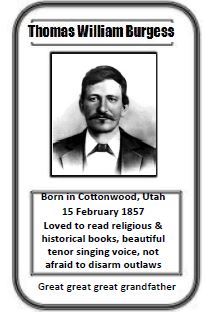
Make Playing Cards with Ancestors' Information


FAMILY HISTORY IDEA—PLAYING CARDS
            Rather than researching, which I should be doing, I seem to find myself making family history “things” for my grandkids.  Somehow my mission has changed to making sure they know about their ancestors.  This is my latest creation.   Perhaps it will be an idea you can use.
            
I found a free template for making baseball cards which I enlarged to 2.75 x 4 inches.  Photos, birth date and place, and information about their likes, personalities, vocation, or something else of interest was included in a card about each grandchild, each of my kids and their spouses, my husband and I, our parents, our grandparents, and our great grandparents (or my grandchildren’s  3rd great grandparents).  Four copies of each card will be given to each family—who are scattered from Seattle to Boston. 

While they play Old Maid, Go Fish, Memory, or just look at the cards, I’m hoping these little kids (and their parents!) will learn something about their ancestors and realize they are part of a large extended family network. 


Sunday, January 22, 2017

A HEADSTONE FOR SOPHIA ATKIN WHETTEN HUFF


                 Sophia Atkin Whetten Huff, my great, great grandmother, lay in an unmarked, unknown grave for nearly ninety years.  Suffering from dementia and convinced family members were trying to kill her, she was committed to the Arizona State Hospital in 1922 where she died December 7, 1924 of pneumonia.  No death certificate exists.  Records at the hospital in Phoenix are not open to descendants and, according to the chaplain, the book linking the grave numbers in the hospital grounds cemetery to names of those buried there has been lost.  assumed we would never know exactly where Sophia was buried.

Born in 1844 in Empingham, Rutlandshire, England, Sophia Atkin crossed the Atlantic at age thirteen with Levi, her seventeen-year-old brother.  Planning to meet their brother William in Philadelphia, William had meanwhile found work 140 miles NW in Sunbury and they were unable to locate him.  Levi turned around and signed on with a ship’s captain as a cabin boy, never to see his family again.  Sophia found various jobs, working her way first to Nebraska, looking for her brother William, and then to Wisconsin where lived her cousin William Haynes.  

In Dane County, Wisconsin, Sophia met and married Englishman John Whetten, but within three years of the marriage John died of pneumonia and widowed Sophia was left with a two-year-old son and a tiny grave holding an infant daughter.  Traveling with the John Murdock wagon train, twenty-year-old Sophia carried young John Thomas and walked across the plains to Utah with her father and sister Adelaide who had arrived from England.  Sadly, Sophia’s mother Elizabeth died prior to emigration,  but they were able to reunite with her brother William after their arrival in Utah.  

The following year Sophia married James Huff, a man whose wife had left him.  Sophia had lived with James Huff’s parents in Nebraska as she earned money to go to Wisconsin.  James, a good mechanic and blacksmith, built sawmills and shingle mills; Sophia, not afraid of hard work, would bunch the shingles together and fasten them into bundles.  James had a roaming nature and moved often to many different towns in Utah and then helped colonize the Little Colorado River area in northern Arizona.  The Indian Agent encouraged them to establish Forest Dale in 1878 and assured them it was not located on the Apache Indian Reservation, but four years later the boundary of  the reservation was moved several miles north, enclosing Forest Dale.  Harassed and threatened by Apaches, the settlers had to leave their homes mid-winter, in February 1882, under conditions of great hardship, suffering from cold and exposure.  Moving to Pinedale and then Juniper (later called Linden) the family oftentimes feared for their lives from the many outlaws in the area. 

In addition to at least two or maybe three more babies who died, Sophia bore James two daughters, Mary Adelaide and Olive, and a son, James, who lived to adulthood.  In 1894 husband James began to suffer from dropsy which proved to be progressively debilitating.  Son John  Thomas Whetten had moved to Mexico a few years earlier and James and Sophia decided to move near him.  In Colonia Garcia James again set up a sawmill and shingle mill, but Sophia was again widowed in 1903 when James died.  She was fifty-nine.

Mexico became engulfed in a Revolutionary War in 1911.  Their guns and ammunition confiscated, in July 1912 the American colonists were told their safety could no longer be guaranteed and were given little more than twelve hours to prepare to leave their homes.  Taking only the bare necessities, women left everything else behind, including family heirlooms.  Then women and children were crowded into train cars and traveled to El Paso, Texas, where they moved temporarily into sheds in a large lumber yard, hanging quilts for privacy.  Within a few years, the colonists began moving back to Mexico, Sophia and her son John among them.  

Both of Sophia’s daughters died in 1921.  In 1922 Sophia left Mexico for Mesa, Arizona and son James in hopes a change of locale would ease her fears, perhaps a remnant of terrifying days of Indians, outlaws and revolutionaries.   It did not.  She was moved to the state hospital.

Linda Despain called every cemetery in Phoenix looking for Sophia’s grave.  Greenwood Memory Lawn Cemetery answered in the affirmative.   We contacted known descendants for donations for a headstone, and once placed, we met at her gravesite, April 4, 2014 (the anniversary of her 170th birthday) for a simple service. 

Sophia no longer lies in an unknown, unmarked grave.  


Tuesday, January 3, 2017

Josiah Winslow, 1606-1674, Did he Suffer from ADHD?


                            JOSIAH WINSLOW, 1606-1674

                            DID HE SUFFER FROM ADHD?


"Incompetent" was a description attached to Josiah Winslow, my 10th great grandfather.  Josiah, youngest brother of Mayflower passengers Gilbert and Edward Winslow, was given many opportunities due to the prominence of his family, but he seems to have had a difficult time meeting expectations.

 Born to Edward Winslow and Magdalen (pronounced Maudlin) Ollyver/Oliver in 1606, Josiah was one of five boys and four girls.  The family was relatively well-off financially and the boys became well-educated. Living in Droitwich, Worcestershire, England, father Edward was Under-sheriff of the County and involved in salt production.

Brothers Gilbert (age 20) and Edward (age 25) arrived in the New World in 1620, John (age 23) the following year, Kenelm in either 1629 (age 30) or 1631 (age 32), and Josiah came in 1631 via the White Angell at the age of 25.  Neither the parents, nor do we have record that their daughters, came to the New World but remained in England.  Father Edward died in England at age 71, the same year his youngest son left for Plymouth.

Josiah's occupation was that of bookkeeper, but perhaps he should have chosen another profession.  In England, Plymouth Colony's investors hired Josiah to keep the accounts and sent him across the ocean. As his brothers Edward and John were influential in the Massachusetts Bay Colony, Josiah was initially accepted.  William Bradford was the Governor at this time and Edward became Governor two years later.

Bradford wrote during the years 1630 to 1651 what has now been published under the title Of Plymouth Plantation.  Regarding their bookkeeper, Josiah, Bradford wrote that he "did wholly fail them and could never give them any account, but trusting to his memory and loose papers, let things run to such confusion that neither he nor any with him could bring things to rights." [Source:  Robert Charles Anderson, "Pilgrim Village Families Sketch:  Josiah Winslow," http://www.americanancestors.org/pilgrim-families-josiah-winslow/]

I wonder if Josiah had a debilitating case of  Attention Deficit Disorder or ADHD?  With ADHD the responsibilities and stress of everyday life may become overwhelming.  Many individuals have difficulty concentrating on a single issue.  They have an inability to focus which can lead to lack of success in work because of an inability to meet deadlines or stay on task.  This may also be accompanied by an inability to prioritize and a lack of short term memory.  [Source:  http://rmhealthy.com/10-signs-symptoms-adhd/1/]

Josiah's oldest brother, Edward, established the town of Marshfield along the coastline, 13 miles to the north of Plymouth, the year after Josiah arrived in Plymouth.  Josiah then made his home in Marshfield.

In 1636, at age 30, Josiah married 28-year-old Margarett Bourne, whose parents and other family members had come to Plymouth in 1630.  Josiah and Margarett had six children: five daughters, Elizabeth, Margaret (my ancestor), Rebecka, Hannah and Mary and one son, Jonathan.  Tragically, the oldest daughter Elizabeth was accidentally killed at age 9 by her 7-year-old brother Jonathan.

Josiah, along with his brothers, was a Marshfield selectman or member of the local town governing board.  He is listed in the Marshfield section of the 1643 Plymouth Colony list of men able to bear arms.  Josiah, like his brother Kenelm (who is also my 10th great grandfather), was Deputy for Marshfield to Plymouth General Court six times between the years 1643-1651.

At the age of 65, Josiah held a position on the Council of War in 1671 when the situation was becoming tenuous with King Philip, the Grand Sachem of the Wampanoag (Indian) Confederacy.  King Philip's War, which would begin four years later, would be not only the greatest calamity in 17th Century New England, but the deadliest war in the entire history of European settlement of North America, in proportion to its population, even more so than the Civil War 200 years later.  Over 600 colonial men, women and children would be killed and 12 towns totally destroyed with many more attacked.  In addition, 3000 Native Americans would die.
[Source:  http://en.wikipedia.org/wiki/King_Philip's_War]  According to this source, Josiah's namesake, his brother Edward's son who was Governor of Plymouth Colony from 1673-1680, was the person most responsible for King Philip's War. [Ibid.]

Although Josiah's wife Margarett would experience the horrors of this war, Josiah would not.  He wrote his will in April 1673; he died less than two years later.  Josiah Winslow was buried December 1, 1674, in Marshfield, Massachusetts "in his sixty-ninth year".

His inventory included one Great Bible and more than 30 additional books.  He left half of his estate, including half of his home to "Margarett my dear and loving wife," the other half to his son Jonathan.  Then he stipulated that if Jonathan should die without heirs, after the death of Jonathan's wife the property should be given to his four daughters and their heirs.

Mistake.  Attention Deficit Disorder?

Previously, at the time of Jonathan's marriage, Josiah gave the property to Jonathan as a wedding present.  Witnesses were called to verify and the Court ruled that Josiah couldn't undo the previous gift by writing something different in his will.

Margarett, Josiah's widow, died nine years after her husband, in September 1683, and was also buried in Marshfield.  She was 75.  Additionally, two of her daughters would die that same year, Margaret (age 43) and Rebecka (40).  Son Jonathan (age 40) preceded his mother in death by four years.


My Line of Descent from Josiah Winslow
Josiah Winslow, Margaret Winslow, Mehitable Miller, Theophilus Crosby, Lemuel Crosby, Lemuel Crosby, Joshua Crosby, Frances Crosby, Benjamin Brown,  Melissa Jane Brown, William J Burgess (my grandfather).


Bibliography
Anderson, Robert Charles.  The Pilgrim Migration--Immigrants to Plymouth Colony 1620-1633  (Boston: Great Migration Study Project, NEHGS, 2004)

Anderson, Robert Charles.  "Pilgrim Village Families Sketch:  Josiah Winslow." http://www.americanancestors.org/pilgrim-families-josiah-winslow/